Portuguese Stoplight Partner ACEGE hosts “What the Stoplight Reveals to Us” Event
Feb 26, 2026


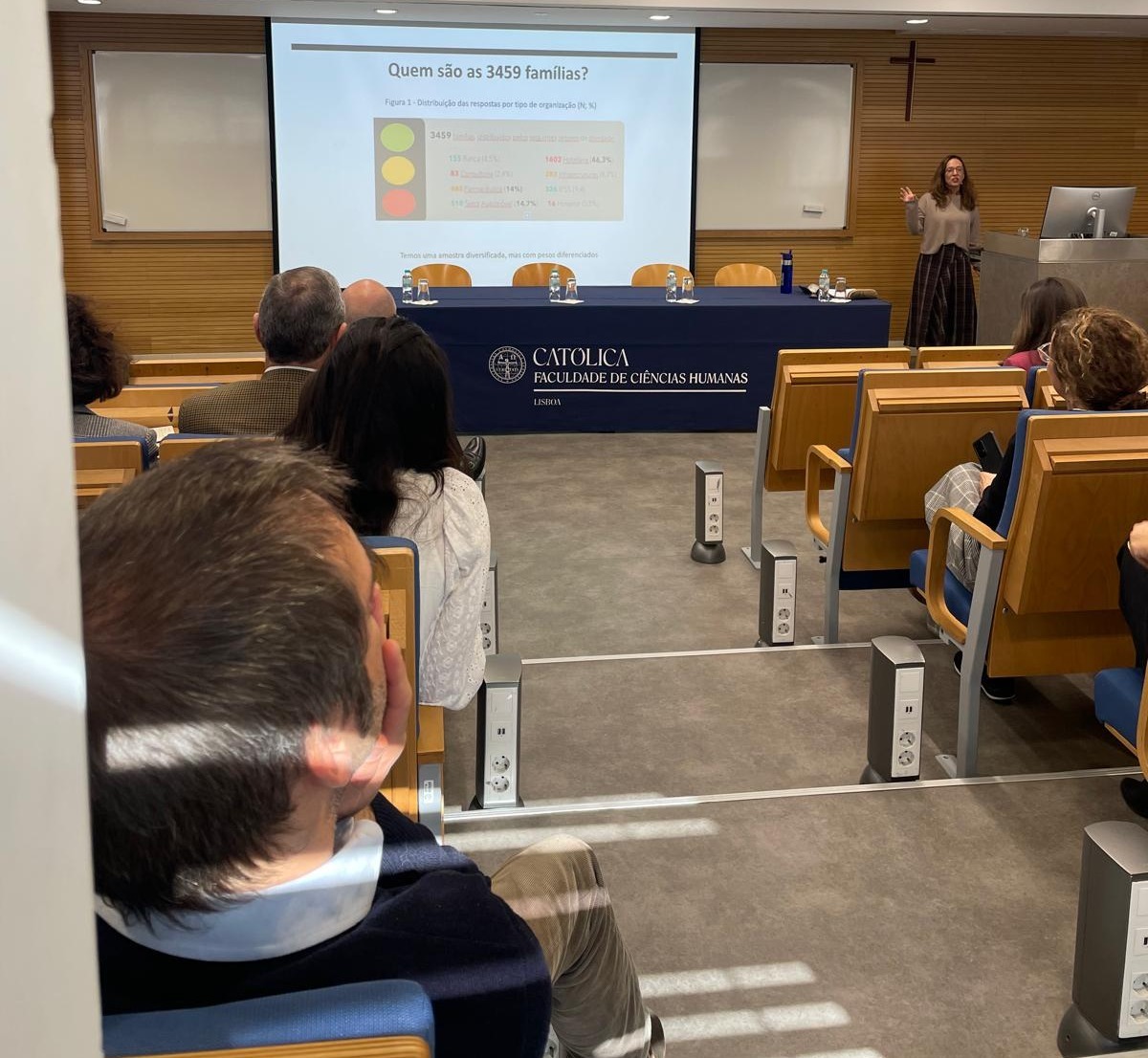
"O que nos revela o Semáforo" ("What the Stoplight Reveals to Us"), took place on 26 February at the Faculdade de Ciências Humanas of the Universidade Católica Portuguesa in Lisbon. During the conference, the Poverty Stoplight methodology and how the tool works were presented, the main findings of the report "Bem-Estar Multidimensional nas Organizações" ("Multidimensional Wellbeing in Organizations") were shared, and a space for reflection was created around the challenges and lines of action for understanding organizations as ecosystems of life and wellbeing.
The event was organized within the framework of GRACE, a business association that promotes a sustainable corporate culture in Portugal, and was held in partnership with ACEGE.
An interesting learning that emerged from this experience is that it worked particularly well to distance the Stoplight from a narrative focused solely on poverty and to frame it instead around the concept of "human flourishing," which was very positively received.
Poverty Stoplight Enters the Workplace: 3,459 Families, 52 Indicators, and a New Way to Read Employee Wellbeing
What happens at home also affects the workplace. That is one of the strongest conclusions from a recent report on the application of the Poverty Stoplight (Semáforo de Eliminação da Pobreza), the Portuguese adaptation of the international Poverty Stoplight, across organizations in different sectors in Portugal. The tool, designed to measure wellbeing across multiple dimensions, is gaining ground in the corporate world as a more precise way to understand the reality of employees and their families.
The study analyzed 3,459 valid responses from families connected to companies and organizations in sectors including hospitality, automotive, pharmaceuticals, banking, consulting, infrastructure, healthcare, and nonprofits (IPSS). The hospitality sector alone accounted for 1,602 responses, or 46.3% of the sample, followed by the automotive sector with 510 and pharmaceuticals with 485. Data collection had national reach, with the strongest concentration in Greater Lisbon (884 responses) and the Algarve (617).
But the most interesting finding isn't the scale. It's how the tool was used. The methodology was applied as a self-assessment process built on 52 indicators organized into 6 dimensions, following a simple and powerful logic: green for stable conditions, yellow for warning signs, red for critical situations. Each participant received their own "life map," a visualization that highlights strengths and priority needs. The report notes that this process does more than generate data. It also fosters reflection, ownership of results, and more active participation in the search for solutions.
The tool wasn't limited to the individual level either. It was also used as an aggregated analysis system by dimension, indicator, and organization type, allowing companies to read patterns of vulnerability and wellbeing with far more depth than a traditional climate or benefits survey. In other words, the Poverty Stoplight was used as a decision-making instrument, aimed at designing internal policies that are more informed, preventive, and aligned with wellbeing and ESG principles.
Key finding: income isn't everything, but it still weighs heavily
The report paints a less linear picture than many companies might expect. The families assessed show solid foundations in several areas, but these coexist with persistent structural fragilities. The three strongest dimensions were: Health & Wellbeing, at 76.7% green, Housing & Infrastructure, at 74.7%; and Interiority & Motivation, at 71.6%
Income & Employment, however, emerged as the most critical dimension. It concentrated the highest share of at-risk responses: 7.1% red and 23.9% yellow, for a total of 31% in vulnerable or warning territory. It was also the dimension with the highest non-response rate (8.9%), which the report interprets as a sign of sensitivity and exposure around economic and employment issues.
The underlying message is a strong one: many people have personal resources, housing stability, or emotional resilience, but that isn't always enough to translate into full wellbeing. Income and economic stability continue to function as a structural bottleneck that shapes access to health, education, culture, participation, and mid-term security.
Corporate wellbeing is no longer measured only within the office
One of the report's most powerful ideas is that companies are not just economic units. They are "ecosystems of life and wellbeing." The report insists that personal life and work life are not separate spheres. Mental health, financial stability, housing, social networks, and motivation all directly influence performance, retention, and engagement at work. At the same time, corporate decisions about salaries, schedules, benefits, and internal culture have a direct impact on families' daily lives.
Within this logic, the Poverty Stoplight emerges as a particularly useful tool for the corporate world, because it makes that interdependence visible. It doesn't just measure material shortfalls. It assesses whether a person can realistically live with autonomy, dignity, and genuine social participation. And that shifts the conversation, from isolated benefits toward a deeper understanding of what sustains, or undermines, the wellbeing of the people who make up an organization.
More stable sectors, more heterogeneous sectors
The study also reveals differences across sectors. Banking, consulting, and pharmaceuticals tended to show higher levels of green in the economic, educational, housing, and health-access dimensions, something the report links to greater job stability, income predictability, and better access to resources.
Hospitality, automotive, and infrastructure, by contrast, showed much sharper heterogeneity, with green, yellow, and red coexisting in significant proportions. Hospitality stands out in particular for the breadth of that internal variation, likely linked to the diversity of roles, seasonality, contract types, and salary differences within the sector.
Nonprofits (IPSS) showed an interesting combination: greater fragility in income and economic stability, but stronger results in housing, health, motivation, and participation. The report reads this as a possible sign of organizational environments with strong social commitment and high relational capital, even with fewer economic resources than more capitalized private sectors.
What matters most: the Poverty Stoplight didn't stop at diagnosis
The report doesn't treat the Poverty Stoplight as a one-time snapshot, but as a tool for action. Among the main recommendations: strengthen existing assets, prioritize interventions on income, economic stability, and social protection, reduce the time, cost, and organizational barriers that limit access to culture and participation, and intervene more specifically on critical indicators such as savings, household budgeting, insurance, heating, access to specialized healthcare, vacations, and community participation.
The most strategic recommendation, however, goes further: consolidate the Poverty Stoplight as a continuous tool for diagnosis, monitoring, and action, rather than using it once. That means embedding it into ongoing improvement processes, organizational learning, and evidence-based internal policy design.
A signal of where the Poverty Stoplight is heading globally
What this case shows extends well beyond Portugal. It shows the Poverty Stoplight expanding into a particularly relevant space: the company as a site of prevention, care, and human development. It is no longer only about measuring poverty in traditional community settings, but about helping organizations better understand the real wellbeing of the people who keep their operations running every day.
And perhaps that's the real story here: the future of corporate wellbeing won't be built on standard benefits packages or HR intuition alone. It will be built with tools capable of reading human complexity with more honesty, more data, and more capacity for action. In that shift, the Poverty Stoplight is already showing it has a place.
 Back to all posts